IEP vs. 504 Plan in NYC: What Every Parent Needs to know
If your child is struggling in school, you may have heard the terms “IEP” and “504 plan” — sometimes in the same conversation. Both are legal documents that provide support for students with disabilities, but they are very different in what they offer, who qualifies, and how they work. For NYC parents navigating the public school system, understanding the distinction can make a significant difference in the support your child receives.
What Is an IEP?
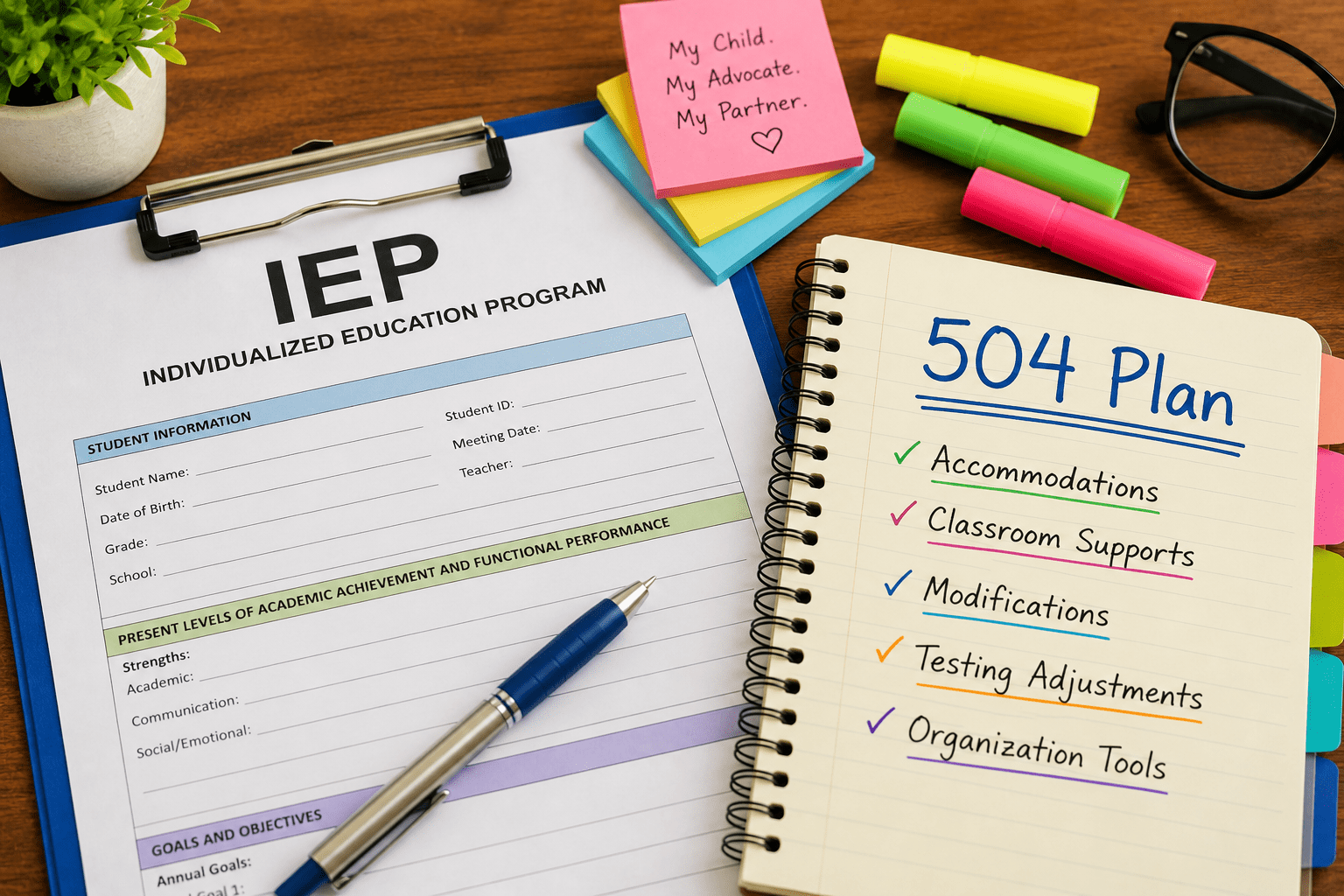
An Individualized Education Program, or IEP, is a legally binding document created under the Individuals with Disabilities Education Act (IDEA). It is designed for students who have a disability that significantly affects their ability to learn in a general education setting. An IEP outlines specific educational goals, the special education services the school will provide, and how progress will be measured.
In New York City, IEPs are developed by a Committee on Special Education (CSE) — or a Committee on Preschool Special Education (CPSE) for children ages 3 to 5. The committee includes the parents, teachers, school administrators, and, when appropriate, the child.
To qualify for an IEP, a child must have one of 13 disability categories recognized under IDEA — including autism, learning disabilities, speech or language impairments, emotional disturbance, and others — and that disability must adversely affect educational performance.
What Is a 504 Plan?
A 504 plan comes from Section 504 of the Rehabilitation Act of 1973, a civil rights law that prohibits discrimination against people with disabilities. Unlike an IEP, a 504 plan does not provide specialized instruction. Instead, it provides accommodations and modifications that help a student access the general education curriculum.
Common 504 accommodations in NYC schools include extended time on tests, preferential seating, reduced homework load, access to a quiet testing environment, and permission to use assistive technology. A 504 plan is often appropriate for students with ADHD, anxiety, physical disabilities, chronic health conditions, or other challenges that affect learning but do not require a specialized curriculum.
Key Differences at a Glance
The biggest difference is the level of support provided. An IEP involves specialized instruction delivered by a special education teacher and can include related services like speech therapy, occupational therapy, or counseling. A 504 plan only provides accommodations within a general education setting.
IEPs also include more legal protections and oversight. Schools are legally required to hold annual IEP reviews and conduct reevaluations every three years. A 504 plan does not carry the same mandatory review schedule, though parents can request a review at any time.
In terms of eligibility, the IEP has a higher bar — the disability must affect educational performance. A 504 plan has a broader standard: the child simply needs a physical or mental impairment that substantially limits a major life activity, which includes learning.
How to Request an Evaluation in NYC
If you believe your child may qualify for either plan, the first step is a formal request. You can submit a written request to your child’s principal or the school’s special education coordinator. NYC schools are legally required to respond within a specific timeframe — typically 10 school days to acknowledge the request and 60 calendar days to complete the evaluation.
For preschool children, contact your local CPSE directly or reach out to Early Intervention services if your child is under three.
Keep all communication in writing and save copies of every letter, email, and document. If the school denies your request, they must provide written notice explaining why.
Which One Does Your Child Need?
This is a common and understandable question, but the honest answer is: it depends on your child’s specific needs, and you don’t have to figure it out alone. Start with an evaluation — the school’s assessment team will help determine which plan is appropriate. You can also consult with an independent educational advocate, which NYC provides free of charge through the Office of Education and Community Services.
If your child already has a 504 plan but continues to struggle despite accommodations, it may be time to request a more comprehensive evaluation for an IEP. And if your child has an IEP and is making strong progress, the team may determine that a 504 plan is sufficient going forward.
Your Rights as a NYC Parent
Both IEPs and 504 plans come with built-in parental rights. You must consent to evaluations. You have the right to review all records. You can request an independent educational evaluation at public expense if you disagree with the school’s evaluation. You have the right to dispute decisions through mediation or an impartial hearing.
The NYC Department of Education has a free special education advocate program. You can also contact Advocates for Children of New York, which provides free legal and advocacy support to families who need help navigating the system.
Understanding the difference between an IEP and a 504 plan is the first step. The next step is knowing your rights — and using them.
Frequently Asked Questions
Can my child have both an IEP and a 504 plan? No. If a child qualifies for an IEP, the IEP replaces the 504 plan. The IEP provides a higher level of support and encompasses the types of accommodations found in a 504.
What if the school refuses to evaluate my child? Schools must provide a written explanation if they refuse to evaluate. You can dispute this decision through the NYC DOE’s impartial hearing process or contact Advocates for Children of New York for free support.
Does a 504 plan follow my child to a new school? Yes. Both IEPs and 504 plans transfer with the student to a new NYC public school. When moving to a new district, notify the new school immediately and provide copies of all relevant documents.



Great tremendous things here. I am very happy to peer your article. Thank you so much and i’m taking a look forward to contact you. Will you kindly drop me a e-mail?
Hore google adalah penguasa dunia saya yang membantu saya menemukan situs internet yang hebat! .
Terima kasih atas kritik yang masuk akal. Saya dan tetangga saya baru saja bersiap untuk melakukan beberapa riset tentang ini. Kami sempat mengambil buku dari perpustakaan lokal kami, tapi saya rasa saya belajar lebih banyak dari postingan ini. Saya benar-benar senang melihat informasi fantastis dibagikan secara bebas.
Saya tidak sering berkomentar tetapi saya harus mengatakan salam untuk posting yang luar biasa ini : D.
Ini benar-benar menjawab masalah saya, terima kasih!
Saya menghargainya, karena saya menemukan persis apa yang saya cari. Anda telah mengakhiri pencarian saya selama empat hari! Tuhan memberkati Anda. Semoga harimu baik. Bye
Dengan segala sesuatu yang mana terlihat sedang dibangun dalam topik spesifik ini, pandangan Anda cenderung agak menyegarkan. Kendati demikian, saya memohon maaf, karena saya tidak dapat setuju sepenuhnya pada seluruh strategi Anda, meskipun menarik. Tampaknya bagi saya bahwa komentar Anda tidak benar-benar tervalidasi dan pada faktanya Anda diri Anda tidak sepenuhnya yakin terhadap argumen tersebut. Dalam hal apa pun saya menghargai membaca.
Ini adalah topik yang sangat dekat di hati saya, cheers, tapi di manakah detail kontak Anda?
Please let me know if you’re looking for a author for your blog. You have some really great articles and I feel I would be a good asset. If you ever want to take some of the load off, I’d really like to write some content for your blog in exchange for a link back to mine. Please send me an e-mail if interested. Kudos!