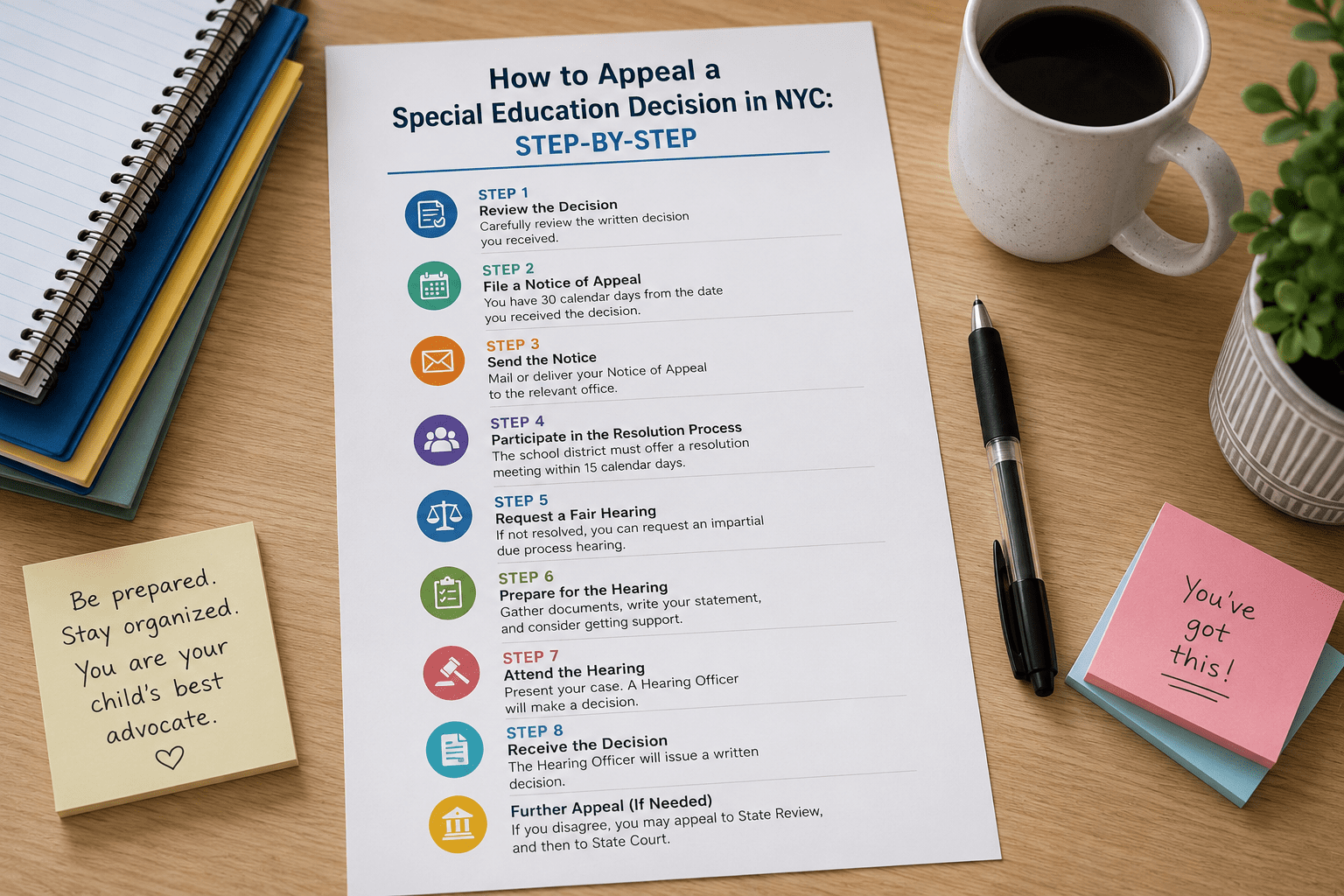
How to Appeal a Special Education Decision in NYC: Step-by-Step
Receiving an IEP recommendation you disagree with — or being told your child does not qualify for special education services — is one of the most stressful experiences a parent can face. The good news is that New York State law gives parents strong rights to challenge these decisions. This guide explains the appeal process step by step, from informal resolution to formal hearing.
Know Your Rights First
Before taking any action, understand that you are an equal participant in the special education process — not a guest at someone else’s meeting. The Individuals with Disabilities Education Act (IDEA) and New York State law guarantee specific rights, including the right to written notice before any change to your child’s services, the right to review all educational records, and the right to dispute any decision through mediation or an impartial hearing.
These rights exist regardless of the reason you disagree — whether it is the eligibility decision, the specific services offered, the placement, or the content of the IEP.
Step 1: Request a Reconsideration Meeting
Before pursuing formal channels, request a reconsideration meeting with the Committee on Special Education (CSE). This is an informal meeting where you can present new information, ask the committee to reconsider its decision, and attempt to reach agreement. Bring any additional documentation you have — medical records, private evaluations, reports from outside providers — that supports your position.
This step is not required, but it often resolves disputes faster and with less stress than formal proceedings.
Step 2: Request Mediation
If the reconsideration meeting does not resolve the issue, mediation is your next option. New York State offers free mediation services through the State Education Department. A trained, neutral mediator will facilitate a discussion between you and the school district to try to reach a voluntary agreement.
Mediation is confidential. Anything said during the process cannot be used as evidence in a later hearing. The mediator does not make a decision — both parties must agree on any resolution. If you reach an agreement, it is written into a binding mediation agreement.
To request mediation, contact the NYS Education Department’s Office of Special Education.
Step 3: File a State Complaint
If you believe the school district has violated a specific state or federal special education law — such as missing a deadline, failing to provide agreed-upon services, or denying required evaluations — you can file a State Complaint with the New York State Education Department (NYSED).
NYSED must investigate the complaint and issue a written decision within 60 calendar days. If a violation is found, NYSED will order corrective action. This option is most appropriate for procedural violations, not disagreements about the appropriateness of services.
Step 4: Request an Impartial Hearing
An impartial hearing is the most formal level of appeal. It is similar to a court proceeding, presided over by an Impartial Hearing Officer (IHO) who is independent of the school district. The IHO reviews evidence, hears testimony, and issues a written decision that is legally binding.
To request an impartial hearing, send a written request to the NYC Department of Education’s Impartial Hearing Office. Your request must include your child’s name and school, the specific issues you are disputing, and the resolution you are seeking.
Once the hearing is requested, the school district generally cannot change your child’s current educational placement — this is known as “stay put” protection. Your child continues to receive current services while the hearing proceeds.
The Hearing Process
After your request is filed, the IHO has specific timeframes to schedule and complete the hearing. You have the right to be represented by an attorney or a lay advocate. You can present evidence, call witnesses, and cross-examine the school’s witnesses.
The IHO will issue a written decision, typically within 45 days of the hearing’s close. If you disagree with the IHO’s decision, you can appeal to a State Review Officer (SRO) and ultimately to federal court.
Getting Free Legal Help
NYC families have access to free legal representation for impartial hearings through several organizations. Advocates for Children of New York provides free legal advocacy and can represent families in hearings. The Legal Aid Society also handles special education cases. Additionally, if you win your impartial hearing, the school district may be required to pay your attorney’s fees.
Do not let concerns about cost prevent you from pursuing your child’s rights. Free help is available.
What If You Win the Hearing?
If the IHO rules in your favor, the school district must comply with the order. This can include providing specific services, changing placement, reimbursing you for private school costs, or compensating for services not provided. The district is required to implement the decision promptly.
If the school district fails to comply with a hearing decision, you can file an enforcement complaint with NYSED or return to the IHO.
Practical Tips
Keep every document. Request all communications in writing. Take notes at every meeting with dates, who was present, and what was said. Request copies of all evaluations and assessments. Know your timelines — missing a deadline can affect your rights.
The process can feel adversarial, but many disputes are resolved before reaching a formal hearing. The key is to be informed, persistent, and to use the free resources available to you.
Frequently Asked Questions
Does requesting a hearing hurt my relationship with the school? It can feel that way, but your legal rights exist specifically because disagreements between parents and schools are common. Many families who pursue hearings continue to have productive relationships with school staff afterward.
How long does an impartial hearing take? From filing to decision, the process typically takes two to four months, though complex cases can take longer.
Can I request a hearing for preschool special education decisions too? Yes. The same impartial hearing process applies to CPSE decisions for children ages 3 to 5.


I like what you guys are up too. Such clever work and reporting! Carry on the superb works guys I have incorporated you guys to my blogroll. I think it will improve the value of my web site 🙂
Have you ever considered creating an ebook or guest authoring on other blogs? I have a blog based upon on the same information you discuss and would love to have you share some stories/information. I know my audience would appreciate your work. If you are even remotely interested, feel free to send me an email.
Wohh tepat apa yang saya cari, salam atas unggahan.
Namun, terima kasih untuk artikel yang hebat ini dan meskipun saya tidak setuju sepenuhnya, saya menilai pandangan.
Postingan yang sangat baik. Ini benar-benar ditulis dengan baik dan mudah dipahami. Terima kasih telah berbagi pengetahuan ini.
Terima kasih atas tulisan yang bagus. Sebenarnya ini sebelumnya adalah sebuah akun hiburan. Terlihat rumit menjadi lebih menyenangkan dari Anda! Namun, bagaimana kita dapat menjaga kontak?
Regards for helping out, wonderful info .